
Author: James Ince
TL;DR
So, agentic AI has entered the sales chat with buzzwords like goal-driven and game-changing. But what does it actually mean?
At its core, agentic AI in sales refers to autonomous, goal-oriented systems that handle complex, multi-step tasks across your sales stack. These aren’t prompt-dependent assistants or dressed-up if-then workflows. They perceive context, plan toward outcomes, and execute across tools – updating your CRM, running research, enriching data – without someone hovering over the keyboard.
Autonomous AI agents like this are moving fast in sales orgs, but the real question is whether you can spot the difference between a genuine AI agent and what amounts to automation with better branding.
Consider this guide your litmus test. You’ll learn how to pressure-test vendor claims against real signals, what outcomes actually justify the spend, and where agents make sense versus where traditional tools still do the job.
If you’ve sat through demos that looked slick but left you wondering what’s truly automated and what still needs manual lift, this will help you separate co-pilots from the real operators.
At its core, an agent is software that understands context in your sales environment, maps out steps toward a goal, executes across multiple systems, and improves based on results. That loop – perceive, plan, act, learn – is what separates agents from less proactive tools that sit waiting for instructions.
Put simply, co-pilots wait for you to click. Agents don’t.
When a qualified lead lands in your CRM, an agent can instantly research the account across 35+ sources, enrich contacts via waterfall lookups across 25+ providers, and update records before your rep lifts a finger.
Strategy is managed in one place, then shared everywhere. You define your ICPs, personas, and qualification rules in a central intelligence layer, and every agent pulls from it. So when you change your ICP to prioritize funded companies, qualification behavior updates immediately without filter rewrites or retraining sessions.
That shift reshapes the human role. You’re no longer doing the legwork; you’re governing it.
The agents handle research and execution, while your team focuses on conversations and closing. This move from execution to governance is what unlocks real, scalable sales capacity.
Here’s what that looks like in practice:
Time reclamation: Reps reclaim 6+ hours per week. Strategic account research drops from 4–5 hours to 11–12 minutes. That’s an order-of-magnitude productivity gain.
Faster cycles: Qualification runs overnight. Research compiles automatically. Contact enrichment completes in parallel through waterfall lookups. Campaigns launch up to 5x faster.
Better lead quality: Agents apply ICP criteria consistently, evaluating accounts against deeper signals – funding, hiring patterns, tech initiatives – that manual processes simply can’t assess at scale. Printful saw 50% improvement in lead quality by using Evergrowth’s AI agents. As Revenue Ops lead, Renars Aptisis, put it: "Lead quality improved by up to 50 percent, and our reps spend more time selling to accounts that actually matter." While Luzmo saw a 30% uptick in phone numbers, along with a 60% better accuracy against their incumbent data source.
Scalable productivity: Ten reps supported by agents can handle workloads that previously required 25–30 people. Your pipeline grows without you needing to add headcount.
24/7 operation: Agents don’t log off. They monitor triggers, research accounts, and enrich records across time zones while your team sleeps.
So, what does agentic AI actually do in a sales team? Well, this is where it gets interesting.
Agents can handle qualification end-to-end. They identify prospects, evaluate them against your ICP using signals beyond firmographics – funding rounds, hiring trends, tech initiatives – score persona fit, and route qualified leads with full context. It runs continuously, processing new leads as they arrive.
Your Agentic AI pulls intelligence from 35+ sources automatically. Company news, financial filings, social signals, job postings, competitive shifts – it’s all monitored. When a target hires a new CIO or raises funding, agents flag it, research the context, and compile a briefing before your rep even spots the opportunity. Work that once took hours happens in minutes.
Agents read and write across CRM, enrichment tools, email platforms, and knowledge bases to keep your stack aligned. Qualifying an account? They enrich the record, verify contacts through waterfall lookups across 20+ providers, log their rationale, update scores, and trigger workflows with zero manual coordination required.
Agents shorten ramp time with simulated scenarios. They roleplay conversations, adapt to rep performance, surface knowledge gaps, and provide targeted recommendations, allowing new hires to practice discovery and objection handling without tying up managers.
Agentic AI weaves research into every interaction. They analyze account signals, map challenges to your value propositions, reference relevant case studies, and draft tailored account plans, talk tracks, voicemail scripts, DMs and more, using centralized ICP and persona intelligence.
All automation isn’t created equal.
Traditional automation runs on fixed if-then logic. Lead score hits 80? Pass it to sales.
Co-pilots wait for instructions. Click a button, get an email draft.
Agentic AI operates differently. It interprets context, decides what to do next, and acts to achieve a defined goal.
The five-point agentic test:
A tool that drafts emails when you click is a co-pilot. A true agent spots a new qualified lead, researches the account, and delivers a complete account plan before you’ve opened your inbox.
Evergrowth’s approach demonstrates that capability in practice. Specialized agents embed research and value context into every engagement, log qualification rationale directly into your CRM, and maintain audit trails that show exactly how conclusions were reached.
So, you’ve got data. Signals. Dashboards lighting up like a Christmas tree. Great.
Now what?
Because insight is lovely. But revenue comes from action. And the truth is most sales stacks are brilliant at spotting opportunities… and oddly clumsy at doing anything about them.
Here’s where agentic AI earns its keep.
Workflow orchestration ties your entire sales stack together. Agents don’t sit politely inside one platform. They move across marketing automation, CRM systems (Salesforce, HubSpot, Microsoft Dynamics), enrichment databases, email tools, and internal knowledge hubs. Qualify a lead? The agent updates your CRM, triggers the right email sequence, adjusts scoring, and logs its rationale in your sales intelligence system.
Waterfall enrichment replaces static databases with intelligent routing. Instead of querying one vendor and shrugging at the gaps, agents cascade through 25+ enrichment providers based on your quality thresholds. Provider A for verification. Good? Move on. Not good enough? Try B. Then C. And so on, until verified data is found or the list is exhausted. You pay only for successful enrichment. The result is 50%+ cost savings versus traditional subscriptions, with stronger data coverage to match.
Goal-driven execution closes the gap between signal and outcome. When a target company hires a new VP of Engineering, the agent doesn’t just wave a flag. It researches the VP, identifies likely pain points, maps them to your value proposition, pulls relevant case studies, drafts a personalized account plan, and queues it for rep review. From signal detection to ready-to-use output, the workflow runs autonomously.
Continuous learning keeps the system sharp. Agents track which qualification criteria convert best, which enrichment providers perform strongest by industry, and which research patterns correlate with closed deals. That feedback loop steadily improves accuracy and efficiency without endless manual rule-tweaking.
Agentic AI doesn’t mean tearing apart the stack you’ve spent years assembling. Modern agentic platforms like Evergrowth sit on top of your existing infrastructure as an intelligence layer. You keep ZoomInfo, Apollo, 6sense, Salesforce etc. Agents simply orchestrate across them, turning raw data into qualified, context-rich outputs. Over time, this orchestration reduces how heavily teams need to rely on each individual point tool, because the agents are handling the coordination, qualification, and research that those systems were never designed to do.
Evergrowth integrates directly with your vendor stack: extracting contacts from Apollo, pulling intent from 6sense, enriching accounts from ZoomInfo, then adding the autonomous qualification and research layer those databases don’t provide. For RevOps teams, that means you can still leverage the vendors you already trust, while gradually consolidating workflows and cutting redundant enrichment, research, and tooling costs that typically accumulate across your GTM stack.
Waterfall enrichment ends the single-vendor gamble. Instead of betting everything on one database, Evergrowth intelligently sequences lookups across 25+ providers. It starts with your preferred source (Apollo, say). If verified data isn’t there, agents cascade automatically – Cognism, ZoomInfo, specialist industry sources – until quality contacts are found or the trail runs dry. That proprietary fallback logic consistently improves coverage versus relying on any single database, no matter how large.
The cost model shifts, too. Traditional subscriptions lock you into per-seat fees whether the data delivers or not – often thousands per month for usable contacts on just 40% of targets. Evergrowth charges only for verified contacts and completed research. Fixed costs become variable, tied directly to outcomes, allowing many teams to report 50%+ savings while improving both coverage and quality. If the waterfall finds nothing, you pay nothing.
Scale alone doesn’t solve the real problem. ZoomInfo’s 320M+ contacts and Apollo’s 200M+ prospects are substantial databases – but they don’t qualify against your ICP, analyze business context, or shape account plans. Reps still shoulder that work, often losing 6+ hours per week. Our agents close the gap by running contacts through your “GTM Brain” – your centralized store of ICPs, personas, and value propositions – to assess fit, surface relevant signals, and produce strategy-aligned outputs.
Implementation stays lightweight. Results sync directly into Salesforce, HubSpot, Pipedrive, or Microsoft Dynamics, so reps stay in familiar workflows while qualification and research run in the background. And unlike tools that require complex builds – custom tables, logic trees, constant maintenance – Evergrowth gives RevOps and sales teams a configurable workspace.
When agents take on research, enrichment, and qualification, sales teams win back 6+ hours per rep, every week. Admin fades into the background. Revenue conversations take centre stage.
Account research that used to swallow 4–5 hours now takes 11–12 minutes. Verified contact data appears automatically. CRM hygiene hums along quietly. Reps log in to qualified accounts, full context, and clear next steps—instead of empty records and a daunting to-do list.
But the boundary matters.
Agents excel at data processing, pattern recognition, and systematic qualification. They don’t read the room. They don’t navigate surprise objections. They don’t build the trust that closes complex deals.
Here’s the split:
Evergrowth draws that line deliberately. Agents qualify accounts, compile research, verify contacts, and draft tailored account plans, then hand over to reps for execution so that outreach stays human. That protects brand voice and avoids the hallucinated facts and off-brand messaging that can sometimes creep into fully autonomous tools.
The end result: agents remove the manual, time-intensive operational load, and your reps get back to selling.
If you’ve armed your sales team with Apollo, ZoomInfo, a polished CRM and they’re still drowning in tabs, it doesn’t mean you need to hire more SDRs just to keep up.
Agentic AI is an intelligence layer that works autonomously, adapts when strategy shifts, and learns from outcomes – giving hours a week back to every rep by handling the systematic work that doesn’t require human judgment.
It runs across your existing stack while you keep strategic control, and turns raw Apollo and ZoomInfo data into qualified, research-backed opportunities you can count on.
Mid-market and enterprise B2B teams with defined ICPs, documented personas, and consultative sales processes see the biggest gains. If reps spend hours researching accounts before every call, if manual qualification creates inconsistency, if growth means linear headcount increases – Evergrowth’s Agentic GTM solution fixes that. You get precise research and qualification at scale, without losing the human edge that closes complex deals.
Ready to move from manual research to strategy-aware execution? See how Evergrowth’s specialized agents qualify against your ICP to deliver complete context straight into your CRM – so your team can focus on closing, not combing through tabs.
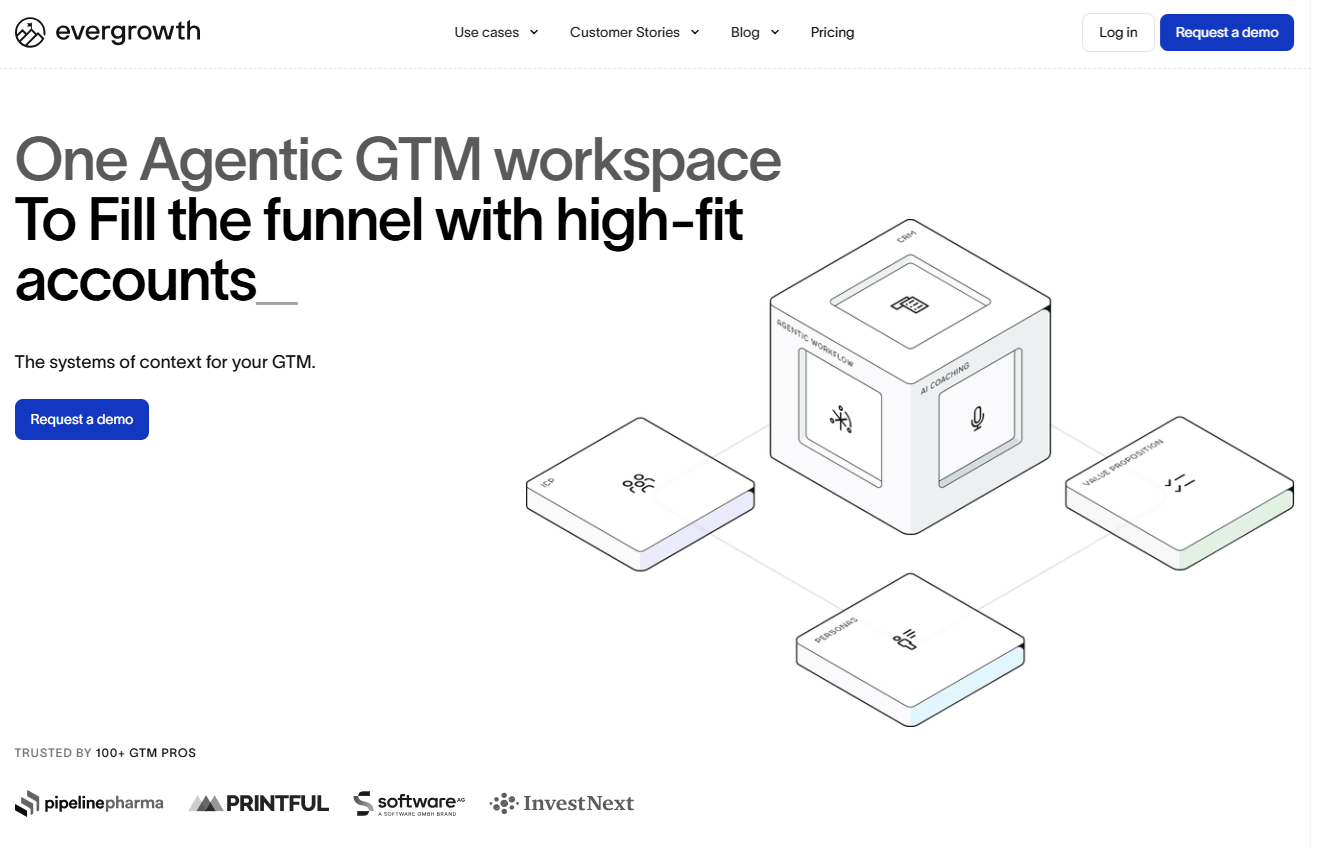
The systems of context for your GTM.

Evergrowth’s Agentic GTM Workspace automates lead research, outreach personalization, and sales training—so your team can close deals faster.