


Author: James Ince
TL;DR:
AI for sales prospecting has evolved far beyond simple email generators and surface-level automation. Modern systems now use Machine Learning (ML), Natural Language Processing (NLP), and Retrieval-Augmented Generation (RAG) to continuously research accounts, detect buying signals, enrich CRM data, score true Ideal Customer Profile (ICP) fit, and prepare personalized outreach at scale. Instead of scouring LinkedIn, guessing who to contact next, teams can rely on AI Agents to surface and prioritize prospects backed by real behavioral and business context.
What hasn’t changed is the need for human connection. The purpose of AI isn’t to replace sales expertise, of course. AI’s purpose is to remove the heavy lifting from administrative tasks (such as manual data entry and cold research) so reps can focus on high-value relationship-building and deal closing.
In the sections ahead, we’ll break down how AI-powered prospecting actually works, which AI tools actually drive results, how to implement them, and how to personalize at scale in a way that’s true to your brand.
Before choosing tools or redesigning workflows, it’s important to understand the different “jobs” AI actually performs in modern prospecting. Most guides lump everything under “AI,” but in practice, a modern sales stack is made up of three very different categories, each solving a distinct problem:
Fundamentally, modern agents perform three critical jobs: automated research across live sources, waterfall enrichment to verify buyer data, and predictive lead scoring that prioritizes true fit. This empowers reps to focus on the accounts most likely to convert.
Tools like LinkedIn Sales Navigator and Lusha aren’t full prospecting engines on their own, but they serve as high-value data inputs. They supply social signals and direct contact details that feed into CRMs and research agents to complete the prospect picture.
The most immediate impact of AI-powered prospecting includes:
“The goal of agentic prospecting isn’t just to fill the pipeline; it’s to fill it with the right people. When you use AI to qualify for fit rather than just volume, you aren’t just improving close rates – you’re securing future growth through retention and expansion.” – JB Daguené, CEO at Evergrowth
AI prospecting reshapes the entire funnel from first signal to first conversation.
It starts with predictive lead scoring, where models analyze historical wins, engagement patterns, and buying signals to surface the accounts most likely to convert. Instead of treating every lead equally, reps begin each day with a prioritized list grounded in real data.
From there, automated research and signal tracking add real-world context. AI continuously scans company news, job changes, hiring patterns, funding announcements, and LinkedIn activity to uncover triggers that explain why an account is heating up – and notifies reps the moment meaningful shifts occur.
That intelligence flows directly into personalized outreach at scale. Rather than generic templates, AI drafts messages and account plans that weave together ICP fit, live signals, and tailored value propositions – allowing reps to engage dozens of accounts with the relevance of manual research.
Across inbound and outbound motions, the same engine applies. Inbound leads are autonomously qualified around the clock against nuanced criteria, while outbound targets are identified and personalized through predefined playbooks and strategic priorities.
Beyond prospecting execution, AI increasingly supports sales training and strategic consistency across the team. Coaching agents can simulate realistic buyer scenarios, objections, and competitive conversations, giving reps on-demand role-play tailored to specific industries, personas, and deal stages, with immediate and actionable feedback.
At the same time, strategy assistants, such as Evergrowth’s digital twin agents, act as always-on Go-to-Market (GTM) advisors. They apply your ICP logic, positioning, and account intelligence to every interaction, guiding reps on what angle to lead with, which pain points to highlight, and when to engage. Instead of relying on memory or static playbooks, reps get real-time strategic context built directly into their daily workflow.
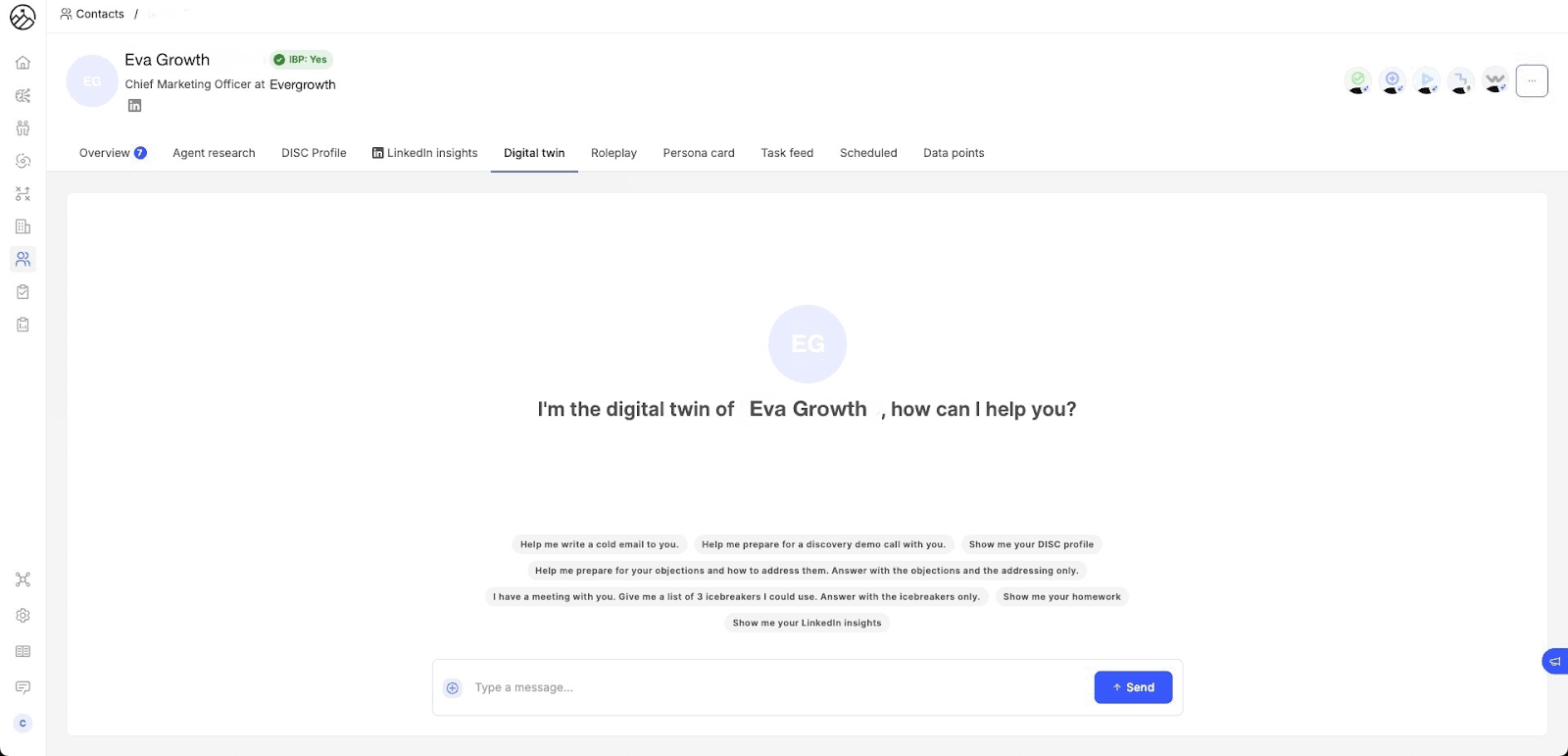
The result is a unified prospecting workflow where insight drives prioritization, prioritization drives personalization, and personalization drives pipeline.
Not all AI prospecting tools solve the same problem. The fastest way to build an effective stack is to match each category to what it does best:
Most tools above are point solutions – powerful at one task but often forcing reps to juggle five to ten tabs to build a single lead’s story.
An agentic workspace like Evergrowth acts as a unified execution engine instead. Rather than stitching tools together manually, centralized intelligence orchestrates a team of AI agents to qualify, research, and enrich leads in one workflow – turning scattered data into an actionable pipeline.
Start by defining clear objectives and success metrics. Identify the biggest gap in your current motion – better lead quality, less research time, or stronger personalization – so AI is deployed with purpose.
Follow the strategy-first rule, which is before touching any tool, codify your ICP, buyer personas, and value propositions in a centralized “brain.” Without this context, AI will default to generic output that weakens your brand.
💻 Pro tip: Take a draft of your AI-generated outreach (email, talk track, or LinkedIn DM) and replace your company name with a competitor’s. If the message still makes perfect sense, your ICP criteria and signals are too broad.
Next comes data hygiene. AI is only as strong as the data it works with. Teams can manually audit their CRM – or use an agentic workspace like Evergrowth to re-qualify, research, and enrich their entire CRM in bulk. This “agentic cleanse” refreshes scoring and prioritization with verified, up-to-date intelligence from day one.
From there, map your playbooks – the step-by-step instructions that guide orchestrated AI agents on what to research, which signals matter, and how to qualify leads. Then, connect your AI workspace directly into your CRM ecosystem, such as HubSpot or Salesforce, so insights flow straight into reps’ daily workflows.
Run short validation sprints, typically two weeks, comparing AI-generated outreach against your best manual efforts to refine tone and relevance. Establish clear human-in-the-loop rules, requiring rep review for high-stakes accounts before messages go out.
Drive adoption by involving reps in building agents around the data they actually want. Also, track outcomes beyond open rates – measure research time saved, meeting conversion rates, and pipeline quality.
Finally, verify platforms have a strong privacy policy and are SOC 2 Type II or ISO 27001 certified and fully GDPR-compliant. Where necessary, ensure your proprietary data isn’t used to train public LLMs.
Enterprise sales teams often pay a heavy “research tax.” For complex, high-value deals, reps can spend four to five hours per account manually digging through news, executive changes, org charts, and product updates just to prepare a single outreach strategy. When targeting a narrow list of strategic accounts, that level of precision is necessary but completely unscalable.
That was the challenge faced by Aqfer before adopting strategy-aware research agents inside Evergrowth.
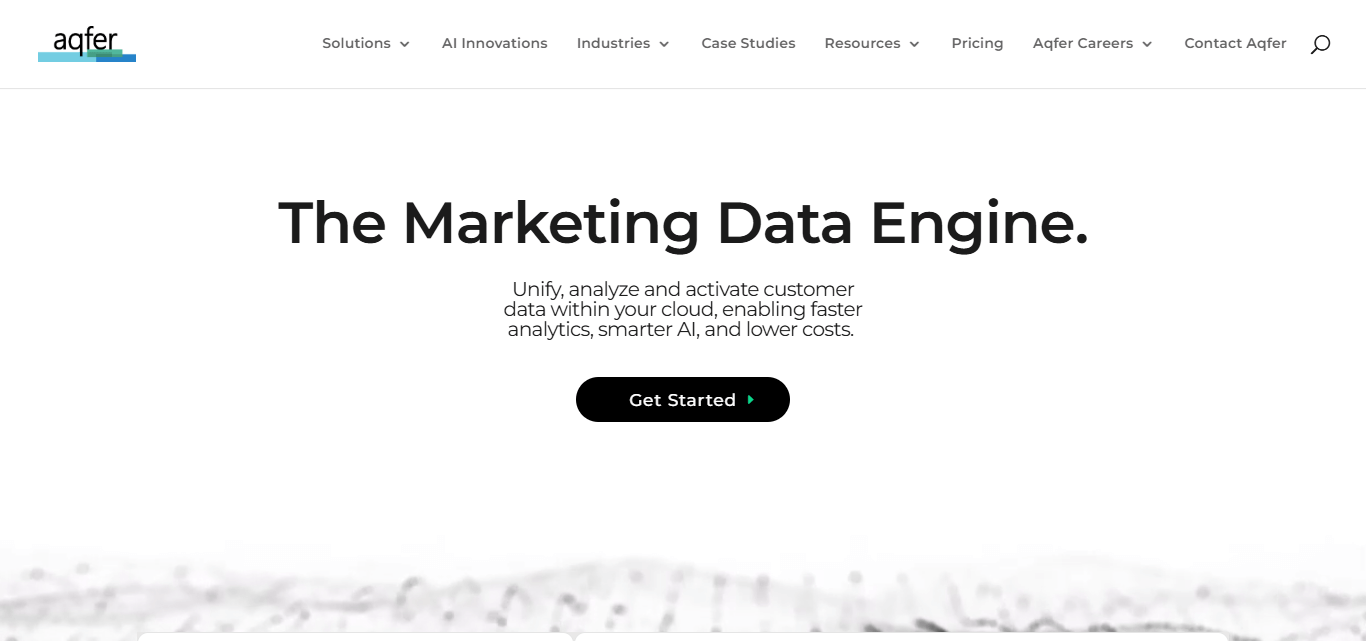
Instead of relying on generic prompts or static filters, the team codified more than 35 specific business signals inside a centralized GTM intelligence layer, ranging from hiring patterns and technology shifts to podcast appearances and leadership moves. These signals told AI exactly what “high-fit” looked like for their motion.
💡 Instead of a "set it and forget it" deployment, for new customers, Evergrowth utilizes a reverse-engineering approach to calibrate agents. The platform analyzes existing best-fit customer data so the AI agents can iterate and refine their decision-making logic. This ensures that when the agents are qualifying leads or finding buyers, their "thinking" mirrors exactly how a top-performing human rep would have prioritized those accounts.
By integrating agents directly into tools like HubSpot and LinkedIn Sales Navigator, research that once took hours was compressed into roughly 11 minutes per account.
The result was smarter execution. Evergrowth’s digital twin agents connected insights across sources and generated creative, highly relevant talking points, allowing reps to manage far more strategic accounts in parallel. At the same time, strategy-aware qualification made it easy to disqualify poor-fit prospects early, keeping the pipeline focused and momentum high.
🌟 The outcome: Strategic research time dropped by over 95%, and reps shifted from grinding through bad-fit deals to building airtight business cases for executive buyers.
The real impact of AI in sales prospecting starts with strategy. When your ICP, signals, and value propositions live in a centralized intelligence layer, every workflow becomes smarter, faster, and more consistent.
From there, success comes from matching each tool to its strength: use databases for fast, high-volume lists, intent platforms for timing and in-market signals, and research agents like Evergrowth for deep qualification and true personalization at scale.
When AI takes over the heavy lifting – research, enrichment, and prioritization –it doesn’t replace the salesperson. It gives them back time, focus, and context to show up where humans win most: building trust, navigating complexity, and turning conversations into long-term revenue.
The systems of context for your GTM.

Evergrowth’s Agentic GTM Workspace automates lead research, outreach personalization, and sales training—so your team can close deals faster.
