


Author: James Ince
TL;DR:
AI lead generation in B2B sales uses autonomous agents, Machine Learning (ML), and Natural Language Processing (NLP) to research, qualify, score, and enrich accounts against your ideal customer profile. This way, sales teams spend time in real conversations instead of jumping between fifteen research tabs.
You can definitely use AI to generate leads, but keep in mind that the biggest wins don’t come from smart algorithms alone. The biggest wins of AI lead generation come from clear ICPs, well-designed workflows, and teams that know how to turn insight into action. Without that foundation, even the most advanced AI simply scales bad targeting faster.
In this post, you’ll see how modern AI lead generation actually works, the technical features that drive real pipeline conversion, how different tool categories fit different sales strategies, and why platforms like Evergrowth are shifting teams from volume chasing to precision-driven growth.
AI lead generation has moved far beyond basic task automation. Today, AI lead generation delivers:
Essentially, reps shift from manual prospecting to automated workflows. This creates a clear human-AI split, with AI handling research, scoring, enrichment, and outreach preparation, while humans handle strategy, creativity, and sales conversations.
In other words, AI becomes the intelligence engine that makes conversation better informed and far more likely to convert, but it doesn’t replace human judgment, trust, or relationship-building.
AI lead generation tools scan large datasets for potential customers and understand which accounts match your ICP. They also automatically prepare and engage with those accounts based on the context they uncover.
Looking ahead to 2026 and beyond, modern AI sales tools have shifted their focus to precision and timing rather than sending more emails to more people. AI lead generation now decides who to contact and when based on real-time behavior and intent signals, instead of relying on static lead lists built once a month.
To do this, leading AI tools use waterfall enrichment, pulling data from 30+ sources sequentially until verified details are found. The logic of this is simple: try a source, verify the result, only pay when there’s a match, log where the data came from, remove duplicates, and write the clean record back into the CRM.
Even better, AI workflows are becoming agentic. AI agents can now run entire early-stage workflows. For example:
This is how AI moves from simple automation to intelligent pipeline creation.
High-performing AI lead generation platforms share five technical capabilities that directly influence pipeline quality and conversion rates:
💡 Pro tip: Successful AI adoption generally follows the 10–20–70 rule: 10% algorithms, 20% technology, and 70% people and processes. Most companies fail because they ignore the 70% – the training and workflow redesign required to actually use the tech – resulting in expensive shelfware, while those that prioritize human adoption see meaningful ROI.
The AI lead generation landscape is broad, but the leading platforms can be grouped by the core philosophy that shapes how they drive the pipeline. Each category solves a different problem and fits a different sales motion.
Let’s unpack how you can align technology with how your team actually closes deals.
The context-first, account-based strategy with platforms like Evergrowth is the right choice when you sell high-ticket B2B solutions and need your AI to function like a senior researcher.
Evergrowth turns scattered tools into a unified GTM Brain through its Agent Training Center, where your ICPs, personas, and value props guide every agent’s decision. This creates strategy-aware logic that can autonomously execute conditional sales plays – triggering the right research or outreach workflow when a specific buying signal appears – so every interaction reflects your broader GTM strategy.
Teams choose the scale and volume strategy with tools like Apollo or Zoominfo when they need a massive, built-in database to fuel a large SDR motion quickly.
The core advantage of this strategy is speed-to-lead: building a list of 1,000 prospects and launching a sequence can happen in under 30 minutes within the same platform.
The technical precision strategy is ideal for RevOps-heavy teams that require ultra-clean data or run conditional, logic-heavy workflows (e.g., “If they use AWS and just hired a CTO, send Email A”). For this, platforms like Clay support highly flexible workflow design, and Cognism provides the gold standard for GDPR-compliant mobile numbers in the EU.
Instead of using traditional tools that chase activity (more emails, more dials), B2B leaders are turning to Evergrowth because it’s built to deliver outcomes (a stronger pipeline and better-fit opportunities). Evergrowth treats your GTM strategy as something living and adaptive, not a static list that decays the moment your market shifts.

A major advantage is the depth of research that Evergrowth’s AI agents perform. Most tools stop at scraping a LinkedIn profile and call it personalization. However, Evergrowth goes several layers deeper by scanning annual reports, financial filings, and long-form company data to uncover the “Why Now” that actually moves enterprise buyers.
Delfos Energy provides a perfect example of this in action. Faced with the impossible task of manually qualifying thousands of leads from massive industry events, they used Evergrowth to automate the entire research process.
“Over the last 10 years at numerous companies in this sector, I’ve always seen this done manually. But using Evergrowth now saves us an incredible amount of time and effort.” – Anton Rimbau, Head of Sales at Delfos Energy.
This is supported by Evergrowth’s Agent Training Center, which is a centralized space where RevOps and Marketing define the ICP and value props once. By cherry-picking accounts that match nuanced ICP criteria, they ensure the pipeline is filled with healthy, high-intent deals that drive stable ARR rather than high-churn risks.

Any strategic change updates the entire AI workforce automatically, so teams aren’t dealing with stale templates or inconsistent messaging.
Evergrowth also brings true CRM-native intelligence. Rather than simply syncing with Salesforce or HubSpot, it operates as an intelligence layer over both–continuously cleaning records and highlighting the highest-intent accounts for reps to prioritize.
The digital twin capability strengthens this even further. Instead of generic AI roleplay, Evergrowth builds a dynamic virtual model of your target buyer.
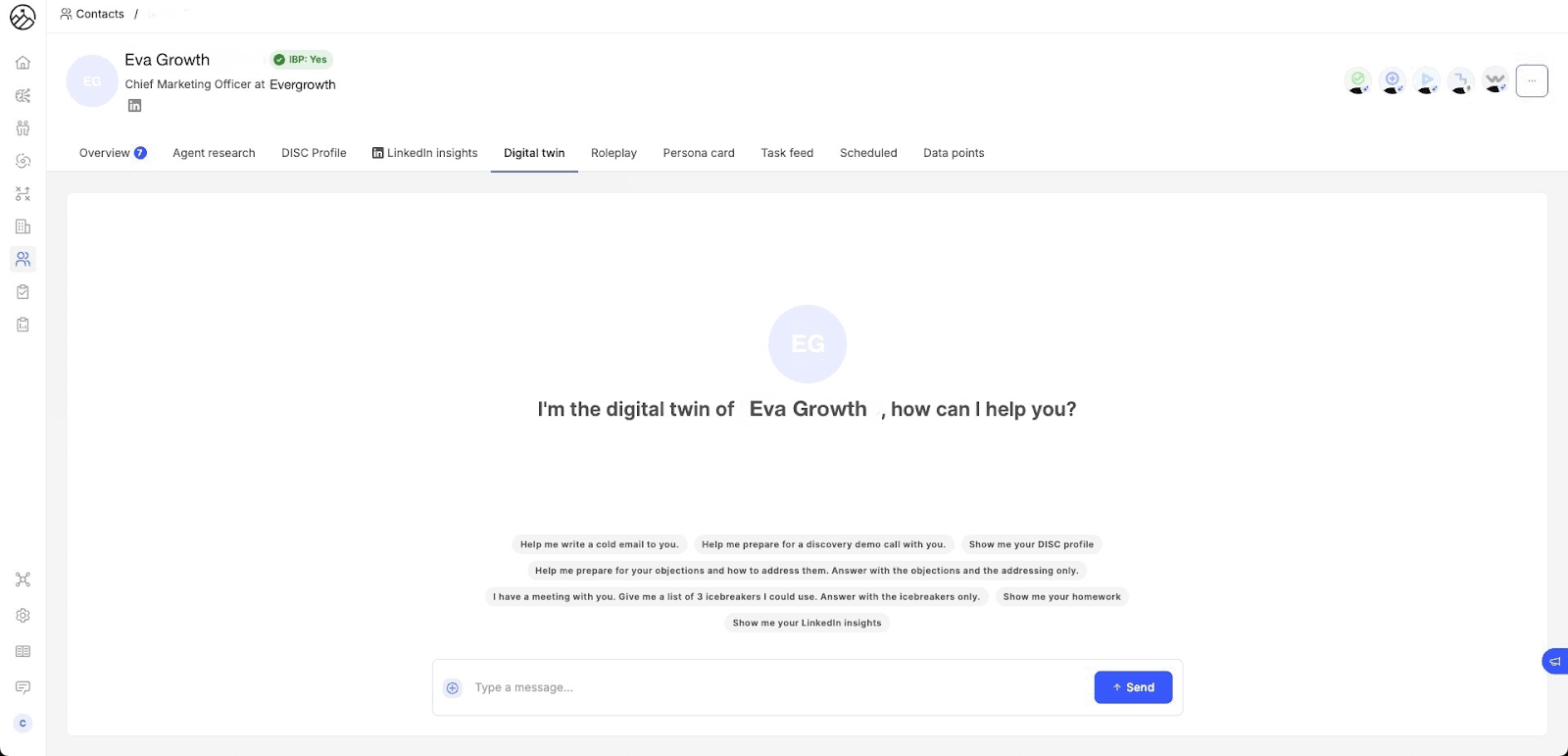
This way, reps approach outreach having already tested their strategy against a twin that reflects real challenges, preferences, and goals, so conversations begin with clarity rather than guesswork.
If you’re still judging outreach by open and click rates, you’re optimizing for attention, not revenue. Modern AI-driven sales teams track performance where buying intent actually shows up:
The goal of these KPIs is more conversations that convert into revenue.
The real win of AI lead generation is booking more meetings with accounts that actually convert, building a pipeline that closes and renews, and freeing reps from endless research so they can focus on real conversations.
Real results come when AI is anchored to clear ICPs, strong processes, and a go-to-market strategy that evolves with your market. That’s exactly what Evergrowth was built for – turning strategy into an always-on AI workforce that finds real buying windows and converts them into a qualified pipeline.
The systems of context for your GTM.

Evergrowth’s Agentic GTM Workspace automates lead research, outreach personalization, and sales training—so your team can close deals faster.
