Artificial intelligence is everywhere right now. Every tool claims to be “AI-powered”, every workflow promises automation, and virtually all teams have already at least experimented with AI by asking tools like ChatGPT to write emails faster or summarize notes.
But that surface-level adoption is exactly why the sales sector hasn’t seen the same returns as other functions. In fact, Bain’s Technology Report 2025 states that sales teams have lagged behind peers in realizing real AI value, despite enormous potential.
TL;DR: Pick tools by the workflow they upgrade—not by “AI features.”
Artificial Intelligence and Sales in 2026 - What Reps and Managers Need To Know
Most sales teams have adopted AI for writing, not executing work, which is why results have lagged.
For 2026 and beyond, the real shift is toward agentic AI – systems that research accounts, validate signals, qualify leads, and prepare outreach autonomously.
Generative AI creates content while agentic AI takes action across the full sales cycle (outbound, inbound, forecasting, enablement).
AI won’t replace sales reps, but reps who use AI well will outperform those who don’t.
You don’t need to replace your stack. The winning model is a layered architecture, where an intelligence layer (like Evergrowth) sits between your data and your CRM to make them both smarter.
Platforms like Evergrowth turn AI from an experiment into execution by delivering ready-to-use sales plays directly inside your CRM.
That’s because most teams stopped at text generation. What’s changing in 2026, though, is the rise of agentic AI – systems that assist reps by actually executing work such as researching accounts, validating signals, qualifying leads, and preparing outreach end-to-end.
In this post, you’ll learn how modern AI actually fits into real sales workflows, what agentic systems change across the sales cycle, and how reps and managers can use AI to reclaim time and drive results without losing control.
What is AI for sales?
Artificial intelligence for sales refers to the use of Machine Learning (ML), Natural Language processing (NLP), and predictive analytics to automate non-selling work, analyze customer signals, and execute complex sales workflows with minimal human input.
AI for sales exists to remove friction from daily work. Instead of manually researching accounts, sorting leads, updating CRM fields, or drafting first-pass outreach, AI systems handle those tasks continuously in the background. In practice, this helps sales teams spend less time preparing and more time selling, without sacrificing accuracy or personalization.
When implemented correctly, AI delivers clear, practical benefits across both inbound and outbound motions:
Increased efficiency: Reps reclaim hours previously spent on research, data entry, and prep.
Higher conversion rates: Better context and timing lead to more relevant outreach.
Faster decision-making: AI surfaces patterns and risks humans miss in large datasets.
Scalability: Teams can run personalized motions across thousands of accounts without linear headcount growth.
Accelerated time-to-market: New segments, plays, and campaigns launch faster with AI-assisted execution.
It’s also important to understand that not all “AI-powered” tools leverage the same types of AI – let’s unpack this:
Machine learning is the pattern engine. It analyzes historical data to identify trends such as which industries convert faster, which signals predict churn, or which deal traits correlate with wins. This powers forecasting, lead scoring, and prioritization.
Generative AI (the current state) uses NLP to create content – emails, call summaries, scripts, and follow-ups. Tools like ChatGPT, Jasper, and Lavender help reps write faster, but they still rely heavily on human-provided context.
Agentic AI (the next state) goes beyond writing. These systems act like digital workers: they browse the web, verify data, monitor signals, qualify leads, and chain multiple tasks together autonomously. Instead of asking “What should I write?” reps get prepared plays ready to review and send.
The distinction between generative and agentic AI is simple: generative AI creates content while agentic AI takes action. One helps you say something better. The other ensures you’re saying the right thing, to the right account, at the right time.
✨ In sales, the future isn’t fully artificial “AI reps,” but AI-augmented humans. This means pairing agentic systems that do the heavy lifting with reps who handle judgment, relationships, and the final mile of closing.
How artificial intelligence works across the sales cycle
AI-powered tools like Sales in Microsoft 365 Copilot made reps more efficient, but they didn’t change how teams identified opportunities or prioritized accounts. That’s why, for sales, it’s essential to shift to agentic AI, which operates continuously and autonomously across both outbound and inbound workflows. Let’s explain how this works:
Prospecting and research (outbound)
Before, outbound AI largely meant using tools like ChatGPT to write “personalized” email intros for static lead lists. The AI generated the text, but the rep still had to do the hardest work – finding relevant context, identifying timing, and deciding which accounts were worth pursuing. Speed improved, but relevance often didn’t.
Now, agentic AI reverses that workflow. Instead of starting with a list, agents continuously monitor live data sources – company news, hiring signals, funding announcements, and 10-K reports – to identify true “why now” moments. The AI then prioritizes and qualifies accounts automatically, pairing each prospect with verified context before the message is written. Outreach becomes research-led, not volume-led, allowing reps to focus on execution rather than guesswork.
Lead qualification (inbound)
Early AI-driven inbound qualification relied on conversational chatbots. These tools were good at answering FAQs and capturing basic information, but they struggled once conversations became nuanced. They couldn’t reliably disqualify poor-fit leads, adapt questioning based on responses, or understand complex buying scenarios – so many low-intent leads still reached reps. Agentic AI changes inbound qualification entirely. Instead of acting like a scripted bot, the AI behaves like a fully trained SDR. It evaluates inbound leads against your ICP in real time, asks intelligent follow-up questions, verifies intent and fit, and routes only qualified meetings to reps. The outcome is fewer wasted calls, faster response times for high-intent buyers, and inbound pipelines that scale without sacrificing quality.
Forecasting and pipeline health
Traditional AI forecasting relied on historical patterns and CRM-entered data to generate win probabilities. While useful, these models often ran on incomplete or outdated information – missing fields, stale close dates, or optimistic rep inputs – making forecasts directionally helpful but operationally fragile. Agentic AI improves forecasting by fixing the inputs, not just the math. Agents actively clean and enrich CRM data, verify deal stages, and surface missing or conflicting information before it reaches the forecast. This ensures predictive models – such as Salesforce Einstein – are based on current, accurate data. Forecasts become less about guesswork and more about reality, giving leaders confidence in pipeline health and revenue projections.
Enablement and coaching
Conversation intelligence tools like Allego and Dialpad focused on what happened after the call. They transcribed conversations, flagged keywords, and analyzed sentiment – often identifying issues only once a deal was already lost or at risk.
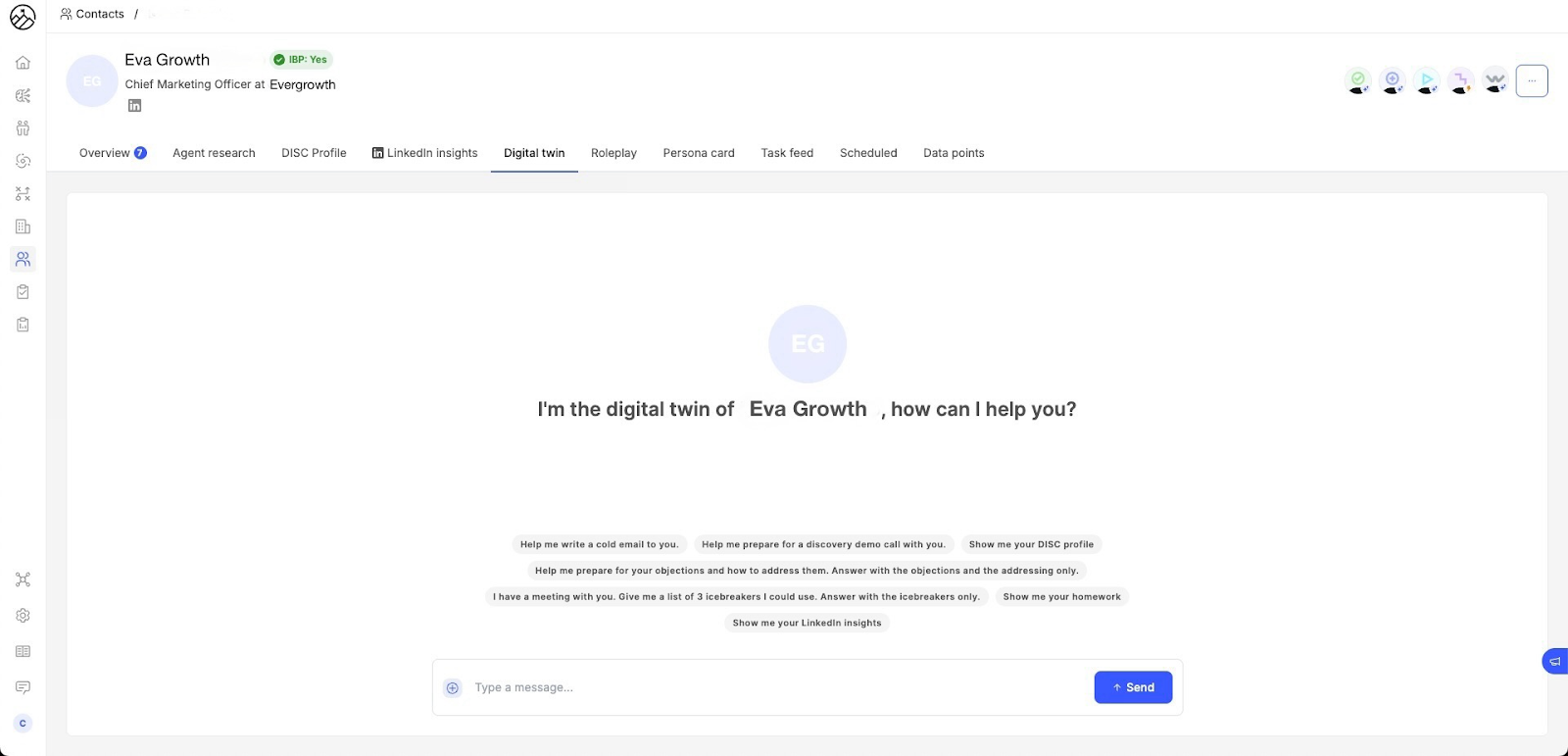
Agentic AI moves enablement upstream. Instead of generic roleplay, reps test their approach against a digital twin agent – an AI mirror of their actual prospect, modeled on industry, role, objections, and communication style. This lets reps validate messaging, pressure-test strategies, and refine positioning before the meeting.
Illustration
While generic roleplay helps new reps practice fundamentals, digital twins are far more valuable for experienced sellers preparing for real, high-stakes conversations – an approach championed by Evergrowth.
Artificial intelligence and sales tools
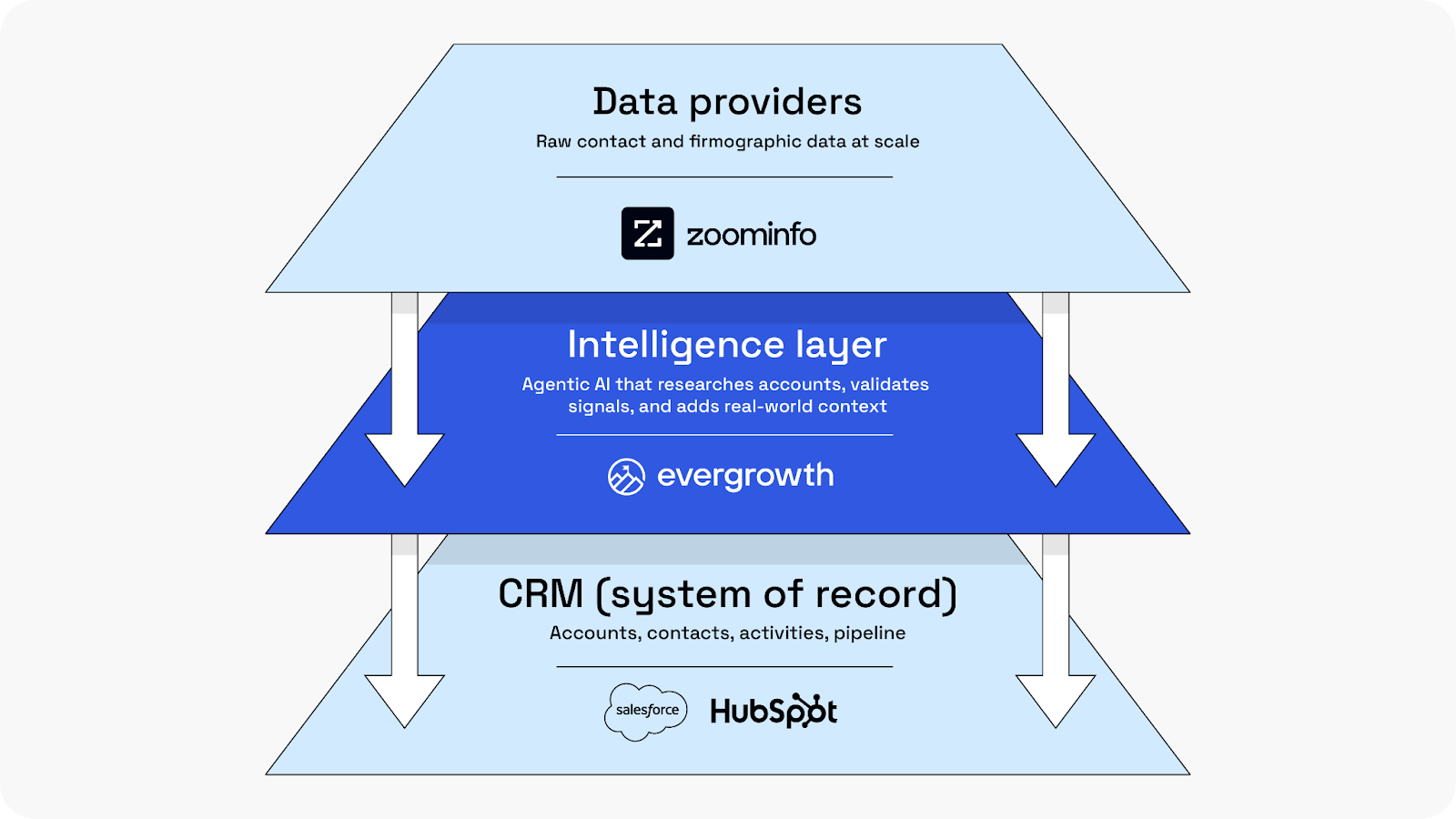
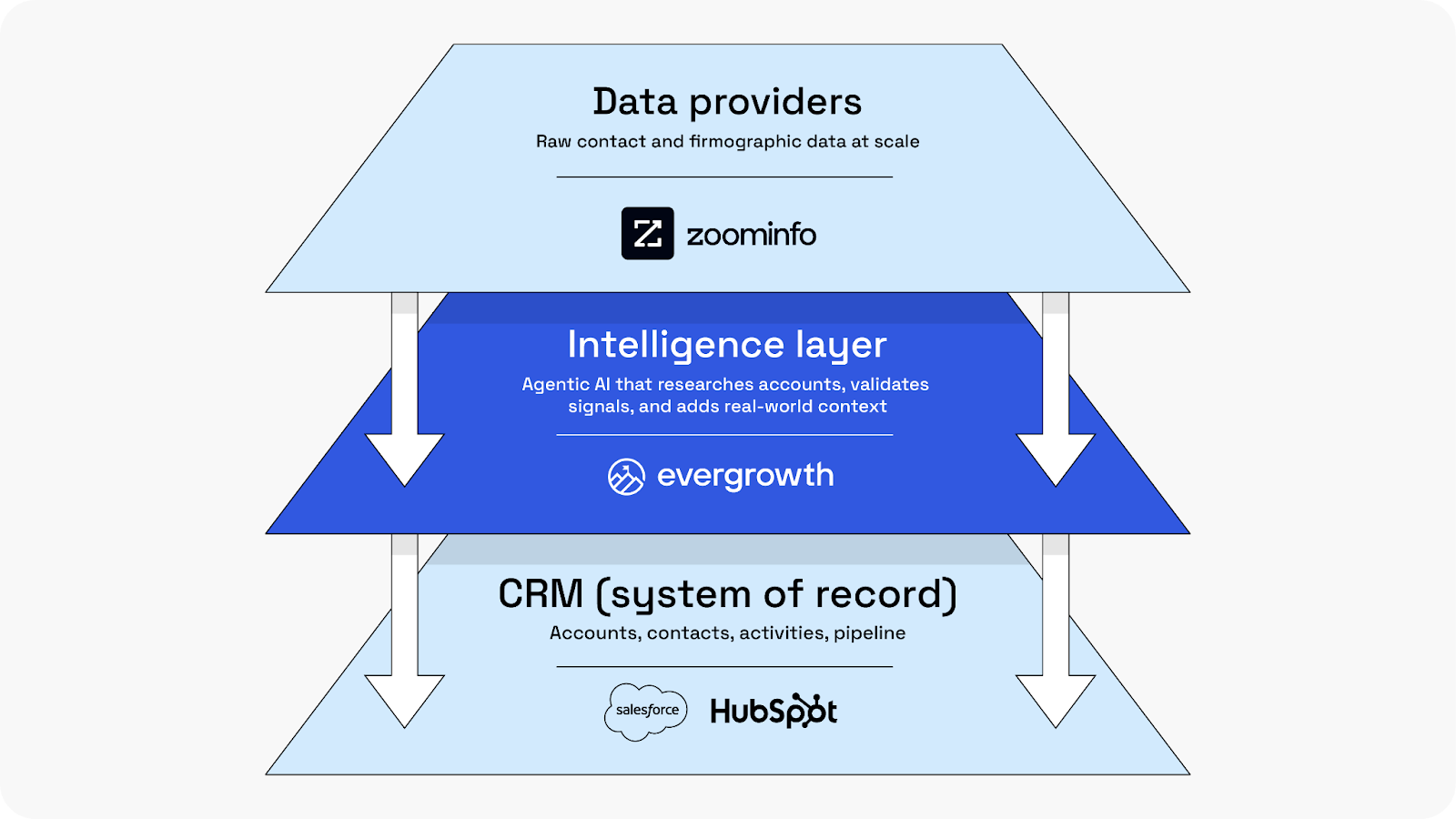
Modern AI for sales works best as a layered architecture, where each category plays a distinct role. Understanding these layers makes it clear where AI agentic workspaces like Evergrowth fit – and why you don’t need to replace your stack to get value from AI.
Illustration
At the foundation sits the CRM. Platforms like Salesforce and HubSpot are the systems of record where accounts, contacts, activities, and pipeline data live. The CRM remains the place where decisions are tracked, revenue is forecasted, and teams operate day to day. Feeding that system is a layer of data providers. Tools such as ZoomInfo, Apollo, or Cognism supply emails, phone numbers, and firmographic data at scale. This information is essential, but it’s largely raw. These platforms tell you who to contact, not why now, and they rarely surface the real-world context that makes outreach timely and relevant. That gap is where the intelligence layer comes in. Platforms like Evergrowth and Clay sit between your data providers and your CRM, acting as the “brain” of the stack. Evergrowth takes raw records from tools like ZoomInfo, uses agentic AI to research accounts, validates signals, and adds meaningful context, then pushes clean, execution-ready insights back into Salesforce or HubSpot. As you can see, instead of stitching together enrichment tools, research workflows, and writing assistants, the intelligence layer replaces fragmented point solutions with a unified engine – one that turns data into action without forcing teams to rebuild their stack.
Artificial Intelligence and Sales in 2026 - What Reps and Managers Need To Know
TL;DR
Most sales teams have adopted AI for writing, not executing work, which is why results have lagged.
For 2026 and beyond, the real shift is toward agentic AI – systems that research accounts, validate signals, qualify leads, and prepare outreach autonomously.
Generative AI creates content while agentic AI takes action across the full sales cycle (outbound, inbound, forecasting, enablement).
AI won’t replace sales reps, but reps who use AI well will outperform those who don’t.
You don’t need to replace your stack. The winning model is a layered architecture, where an intelligence layer (like Evergrowth) sits between your data and your CRM to make them both smarter.
Platforms like Evergrowth turn AI from an experiment into execution by delivering ready-to-use sales plays directly inside your CRM.
Artificial intelligence is everywhere right now. Every tool claims to be “AI-powered”, every workflow promises automation, and virtually all teams have already at least experimented with AI by asking tools like ChatGPT to write emails faster or summarize notes.
But that surface-level adoption is exactly why the sales sector hasn’t seen the same returns as other functions. In fact, Bain’s Technology Report 2025 states that sales teams have lagged behind peers in realizing real AI value, despite enormous potential.
That’s because most teams stopped at text generation. What’s changing in 2026, though, is the rise of agentic AI – systems that assist reps by actually executing work such as researching accounts, validating signals, qualifying leads, and preparing outreach end-to-end.
In this post, you’ll learn how modern AI actually fits into real sales workflows, what agentic systems change across the sales cycle, and how reps and managers can use AI to reclaim time and drive results without losing control.
What is AI for sales?
Artificial intelligence for sales refers to the use of Machine Learning (ML), Natural Language processing (NLP), and predictive analytics to automate non-selling work, analyze customer signals, and execute complex sales workflows with minimal human input.
AI for sales exists to remove friction from daily work. Instead of manually researching accounts, sorting leads, updating CRM fields, or drafting first-pass outreach, AI systems handle those tasks continuously in the background. In practice, this helps sales teams spend less time preparing and more time selling, without sacrificing accuracy or personalization.
When implemented correctly, AI delivers clear, practical benefits across both inbound and outbound motions:
Increased efficiency: Reps reclaim hours previously spent on research, data entry, and prep.
Higher conversion rates: Better context and timing lead to more relevant outreach.
Faster decision-making: AI surfaces patterns and risks humans miss in large datasets.
Scalability: Teams can run personalized motions across thousands of accounts without linear headcount growth.
Accelerated time-to-market: New segments, plays, and campaigns launch faster with AI-assisted execution.
It’s also important to understand that not all “AI-powered” tools leverage the same types of AI – let’s unpack this:
Machine learning is the pattern engine. It analyzes historical data to identify trends such as which industries convert faster, which signals predict churn, or which deal traits correlate with wins. This powers forecasting, lead scoring, and prioritization.
Generative AI (the current state) uses NLP to create content – emails, call summaries, scripts, and follow-ups. Tools like ChatGPT, Jasper, and Lavender help reps write faster, but they still rely heavily on human-provided context.
Agentic AI (the next state) goes beyond writing. These systems act like digital workers: they browse the web, verify data, monitor signals, qualify leads, and chain multiple tasks together autonomously. Instead of asking “What should I write?” reps get prepared plays ready to review and send.
The distinction between generative and agentic AI is simple: generative AI creates content while agentic AI takes action. One helps you say something better. The other ensures you’re saying the right thing, to the right account, at the right time.
✨ In sales, the future isn’t fully artificial “AI reps,” but AI-augmented humans. This means pairing agentic systems that do the heavy lifting with reps who handle judgment, relationships, and the final mile of closing.
How artificial intelligence works across the sales cycle
AI-powered tools like Sales in Microsoft 365 Copilot made reps more efficient, but they didn’t change how teams identified opportunities or prioritized accounts. That’s why, for sales, it’s essential to shift to agentic AI, which operates continuously and autonomously across both outbound and inbound workflows. Let’s explain how this works:
Prospecting and research (outbound)
Before, outbound AI largely meant using tools like ChatGPT to write “personalized” email intros for static lead lists. The AI generated the text, but the rep still had to do the hardest work – finding relevant context, identifying timing, and deciding which accounts were worth pursuing. Speed improved, but relevance often didn’t.
Now, agentic AI reverses that workflow. Instead of starting with a list, agents continuously monitor live data sources – company news, hiring signals, funding announcements, and 10-K reports – to identify true “why now” moments. The AI then prioritizes and qualifies accounts automatically, pairing each prospect with verified context before the message is written. Outreach becomes research-led, not volume-led, allowing reps to focus on execution rather than guesswork.
Lead qualification (inbound)
Early AI-driven inbound qualification relied on conversational chatbots. These tools were good at answering FAQs and capturing basic information, but they struggled once conversations became nuanced. They couldn’t reliably disqualify poor-fit leads, adapt questioning based on responses, or understand complex buying scenarios – so many low-intent leads still reached reps.
Agentic AI changes inbound qualification entirely. Instead of acting like a scripted bot, the AI behaves like a fully trained SDR. It evaluates inbound leads against your ICP in real time, asks intelligent follow-up questions, verifies intent and fit, and routes only qualified meetings to reps. The outcome is fewer wasted calls, faster response times for high-intent buyers, and inbound pipelines that scale without sacrificing quality.
Forecasting and pipeline health
Traditional AI forecasting relied on historical patterns and CRM-entered data to generate win probabilities. While useful, these models often ran on incomplete or outdated information – missing fields, stale close dates, or optimistic rep inputs – making forecasts directionally helpful but operationally fragile.
Agentic AI improves forecasting by fixing the inputs, not just the math. Agents actively clean and enrich CRM data, verify deal stages, and surface missing or conflicting information before it reaches the forecast. This ensures predictive models – such as Salesforce Einstein – are based on current, accurate data. Forecasts become less about guesswork and more about reality, giving leaders confidence in pipeline health and revenue projections.
Enablement and coaching
Conversation intelligence tools like Allego and Dialpad focused on what happened after the call. They transcribed conversations, flagged keywords, and analyzed sentiment – often identifying issues only once a deal was already lost or at risk.
Agentic AI moves enablement upstream. Instead of generic roleplay, reps test their approach against a digital twin agent – an AI mirror of their actual prospect, modeled on industry, role, objections, and communication style. This lets reps validate messaging, pressure-test strategies, and refine positioning before the meeting.
While generic roleplay helps new reps practice fundamentals, digital twins are far more valuable for experienced sellers preparing for real, high-stakes conversations – an approach championed by Evergrowth.
Artificial intelligence and sales tools
Modern AI for sales works best as a layered architecture, where each category plays a distinct role. Understanding these layers makes it clear where AI agentic workspaces like Evergrowth fit – and why you don’t need to replace your stack to get value from AI.
At the foundation sits the CRM. Platforms like Salesforce and HubSpot are the systems of record where accounts, contacts, activities, and pipeline data live. The CRM remains the place where decisions are tracked, revenue is forecasted, and teams operate day to day.
Feeding that system is a layer of data providers. Tools such as ZoomInfo, Apollo, or Cognism supply emails, phone numbers, and firmographic data at scale. This information is essential, but it’s largely raw. These platforms tell you who to contact, not why now, and they rarely surface the real-world context that makes outreach timely and relevant.
That gap is where the intelligence layer comes in. Platforms like Evergrowth and Clay sit between your data providers and your CRM, acting as the “brain” of the stack. Evergrowth takes raw records from tools like ZoomInfo, uses agentic AI to research accounts, validates signals, and adds meaningful context, then pushes clean, execution-ready insights back into Salesforce or HubSpot.
As you can see, instead of stitching together enrichment tools, research workflows, and writing assistants, the intelligence layer replaces fragmented point solutions with a unified engine – one that turns data into action without forcing teams to rebuild their stack.
How to implement AI in your sales process
The biggest mistake teams make with AI is starting with automation instead of strategy.
"Most teams try to skip the strategy phase. They just plug in AI and expect magic. But if you haven't explicitly taught the system your ICP, your personas, and your value props, you aren't automating sales – you’re just automating noise." – JB Daguené, CEO at Evergrowth.
AI doesn’t fix broken processes. A successful rollout, regardless of the tool you choose, follows a clear, deliberate sequence that prioritizes context before execution:
Start with your data: If your CRM is cluttered with outdated accounts, missing fields, or inconsistent stages, AI agents will inherit those flaws. Before introducing automation, clean and standardize the inputs your AI will rely on. High-quality data isn’t a “nice to have”; it’s the difference between helpful output and noise.
Define your strategy: AI can’t infer who you sell to or why customers buy. You have to teach it. That means providing clear ICP definitions, buyer personas, value propositions, and positioning so the system has a reliable source of truth to work from. This strategy-first foundation is what allows AI to act consistently across workflows.
Don’t automate everything at once: The fastest path to value is to focus on a single, high-friction workflow – event follow-up, inbound lead research, or account prep – so you can get a live agent-driven process running within weeks, not months.
Augment, don’t replace: Think of AI as a team of digital interns who handle 90% of the prep work (research, drafting, and coordination) while reps apply final judgment and execution in the 10% that truly drives revenue.
Train and validate continuously: Like new hires, AI agents improve with feedback. Implement review loops where humans grade outputs, refine prompts, and correct errors. Over time, this process turns AI from a novelty into a dependable part of your sales operation.
The challenges and risks to plan for
The sales teams that succeed with AI in 2026 and beyond are the ones that plan for its limitations upfront, rather than discovering them mid-rollout.
One of the biggest constraints is data dependency. AI tools don’t generate accurate phone numbers, job titles, or company details on their own – they rely on third-party data providers. That means coverage gaps, regional inconsistencies, and outdated records will still exist. AI can enrich and validate data, but it can’t invent information that isn’t available.
There’s also the autonomy trap. The idea of “set it and forget it” outbound is appealing – and dangerous. Fully autonomous outreach without human review can quickly drift off-message, misuse context, or create brand risk. High-performing teams keep a human in the loop, especially at the final execution stage.
This leads to two common questions:
Will AI replace sales reps?
Is AI-generated content ready to send without review?
The short answer to both is no. AI won’t replace great reps, but reps who know how to use AI well will outperform and potentially replace those who don’t. Instead, as the Revenue Formula podcast explores, it will create a new breed of 'Super Rep' (or $5M AE) who use agents to run hyper-optimized workflows. Those at the forefront of using artificial intelligence in sales won't just survive; they will raise the bar across the entire industry.
Finally, there’s the adoption curve. Managing AI agents is a different skill from managing email templates. It requires new workflows, new training, and a mindset shift toward supervising systems. This shift carries real risk: 95% of enterprise AI solutions fail to reach production, largely because teams reject static tools that can't adapt to their daily reality. You need to choose tools that adapt to your existing workflow to ensure your rollout doesn't become part of that statistic.
That’s why ongoing optimization matters. Programs like Evergrowth Expert Hours exist to keep AI aligned with real sales strategy – long after initial setup – so teams continue improving instead of plateauing.
Your next step with AI in sales
The sales teams that win won’t be the ones with the longest list of AI tools – they’ll be the ones with the best context-driven execution. Knowing why an account matters, when to engage, and how to tailor the approach at scale is what separates high performers from everyone else.
While basic generative AI tools can help polish a sentence, they don’t understand your ICP, your positioning, or what actually moves deals forward. They speed up output, but they don’t improve judgment.
The next evolution is clear: sales teams need digital interns – agentic systems that research accounts, validate signals, draft emails, script cold calls, and prepare complete plays before a rep ever steps in. AI should deliver execution-ready work, not more tabs to manage.
If your team is still spending hours every week on manual prep, you’re leaving productivity on the table.